Japan Showcases its Decarbonization Technologies to the World at COP30!
Joint pledge on sustainable fuels garners attention
(Provisional translation)
(English ver.) 2026-05-14

From November 10 to 22, 2025, COP30, a conference in which nations from around the world met to discuss climate change, was held in Belém, Brazil. In addition to Brazil, the host country, leaders from the United Kingdom, France, Germany, and other nations attended, and from Japan, Minister of the Environment Ishihara Hirotaka participated as head of the delegation, representing the Government of Japan. This article will focus on the decarbonization technologies and initiatives that Japan presented through the Japan Pavilion and seminars.
Japan’s Three Key Messages to the World
At the 30th session of the Conference of the Parties to the United Nations Framework Convention on Climate Change (COP30), held in Belém, a city at the mouth of the Amazon River, the theme was “Mutirão”—a Portuguese term meaning “collaboration”—and discussions focused on accelerating the implementation of the Paris Agreement and advancing international cooperation. The outcomes were announced on the final day as the Belém Political Package.
Japan actively contributed to the discussions by participating in numerous negotiation forums, as well as proactively communicating its message through technology exhibitions at the Japan Pavilion and by expressing support for various initiatives.
Japan’s basic stance was conveyed through three main messages to the world. The first of these is the concept of simultaneously achieving emissions reduction, economic growth, and energy security—the Triple Breakthrough. The second is the importance of various pathways (a multi-pathway approach) in achieving carbon neutrality by 2050. Third, while Japan’s greenhouse gas (GHG) emissions account for only 3% of the global total, it needs to contribute not only to its own decarbonization but also to global decarbonization. In particular, the decarbonization of Asia, which accounts for more than half of global GHG emissions, is crucial.
Three Messages from Japan
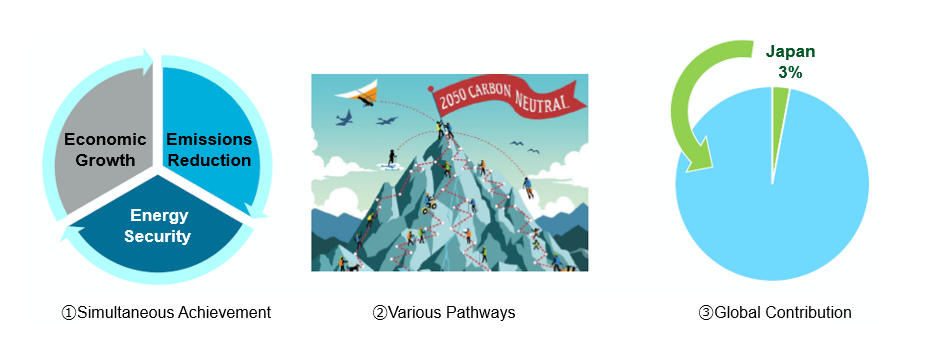
Achieving global net-zero emissions is an extremely ambitious goal, and it cannot be realized unless the measures taken are feasible for each country. It is essential that Japan contribute to global decarbonization through its technologies.
Joint Proposal for the Belém 4X Pledge on Sustainable Fuels
At COP30, Brazil, Japan, and Italy co-sponsored the Belém 4X Pledge on Sustainable Fuels. The Pledge sets a goal of expanding the global use of sustainable fuels—such as biofuels ( What is Sustainable Aviation Fuel (SAF)? Turning Aviation into a Clean Means of Transportation!), synthetic fuels, and synthetic methane—by at least four times the 2024 level by 2035. To achieve this goal, Japan plans to actively pursue the necessary initiatives and international cooperation.
While promoting the use of sustainable fuels across a wide range of sectors—including transportation (such as aviation, maritime, and road transport) and industry—the Pledge emphasizes the importance of decarbonization, particularly in the road transport sector, by combining sustainable fuels with high-performance mobility technologies such as hybrid engines.
Japan views the use of sustainable fuels as a key component of the diverse pathways toward carbon neutrality. On September 15, 2025, Japan hosted the inaugural Ministerial Conference on Sustainable Fuels in Osaka. This conference was co-hosted by Japan and Brazil as part of the ISFM (Initiative for Sustainable Fuels and Mobility) initiative. At the meeting, the International Energy Agency (IEA) presented findings stating that “the production and use of sustainable fuels will increase at least fourfold by 2035 compared to 2024.” A report with the same message was also released prior to COP30, and the 4X Pledge on Sustainable Fuels at COP30 serves to translate the outcomes of the discussions at the Osaka meeting into concrete actions.
Learn More
- International Conferences in Osaka on Sustainable Fuels and Hydrogen Held Together with an Expo Site Visit Sharing Japan’s Efforts with the World (Part 1)
- International Conferences on Sustainable Fuels and Hydrogen Held in Osaka with Expo Site Visit Sharing Japan’s Efforts with the World (Part 2)
The Belém 4X Pledge on Sustainable Fuels was initiated by Brazil at the Pre-COP on October 14 and formally announced by Brazilian President Lula at the COP Summit on November 7. As of November 14, 23 countries and regions have expressed their support, and the plan is to continue recruiting additional signatories.
President Lula’s Announcement at the Summit on November 7
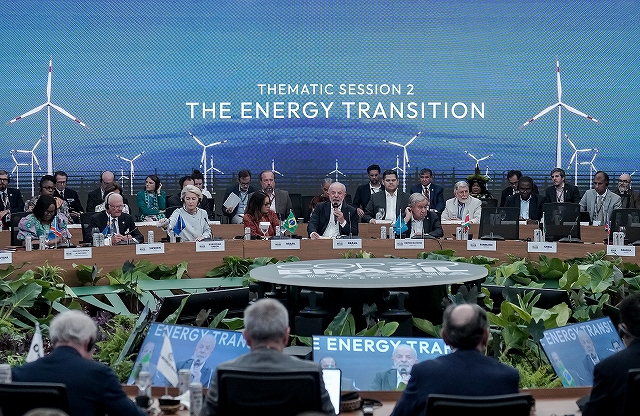
(Source) COP30 BRASIL AMAZONIA: “Lula at Climate Summit: ‘Brazil is not afraid to discuss the energy transition’”
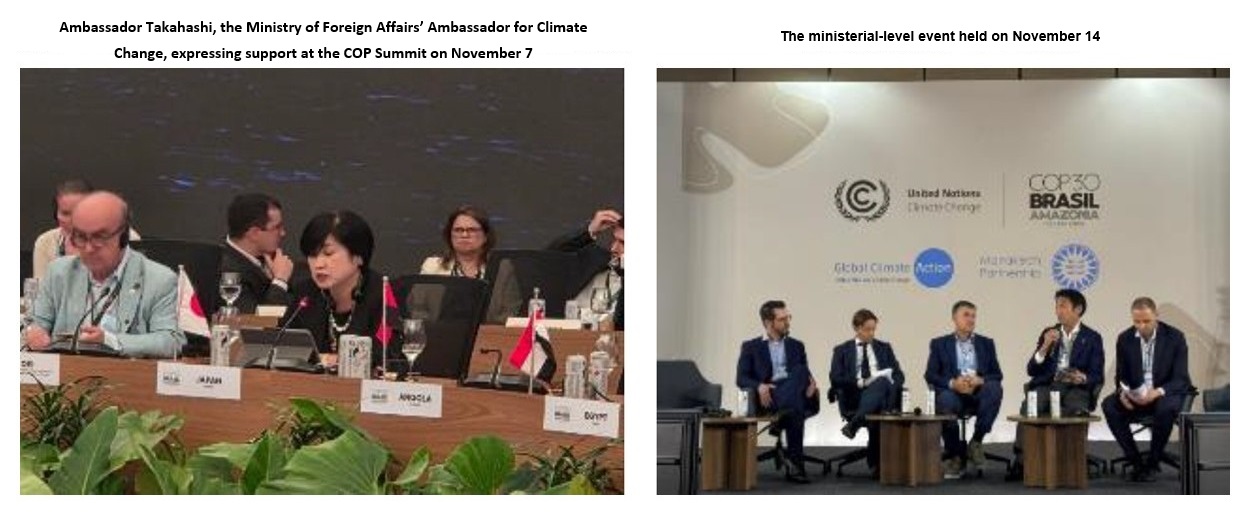
Showcasing Unique Technologies and Initiatives: the Japan Pavilion and Seminars
A Japan Pavilion was set up at the COP30 venue, featuring exhibits from nine companies. Throughout the event, Japan showcased its technologies and initiatives related to renewable energy, energy storage, energy conservation, construction materials, satellite data utilization, and waste recycling.
In addition, to convey the Three Key Messages from Japan mentioned at the beginning, 30 seminars were held during the event. The themes covered a wide range of fields, including strengthening cooperation between Japan and Indonesia under the AZEC framework, promoting transition finance, decarbonizing industry, and utilizing sustainable fuels.
Learn More
Seminars hosted by METI held at the COP30 Japan Pavilion
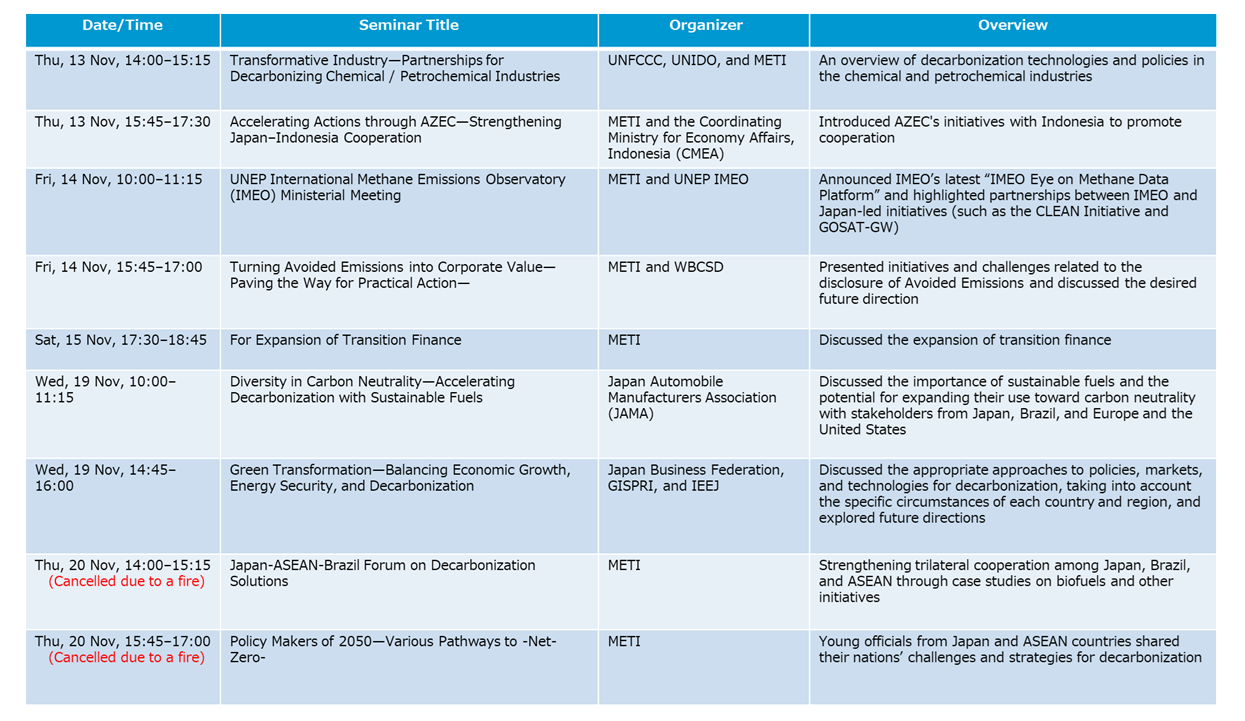
JAMA and Japan Business Federation Share Insights on Sustainable Fuels and Diverse Pathways
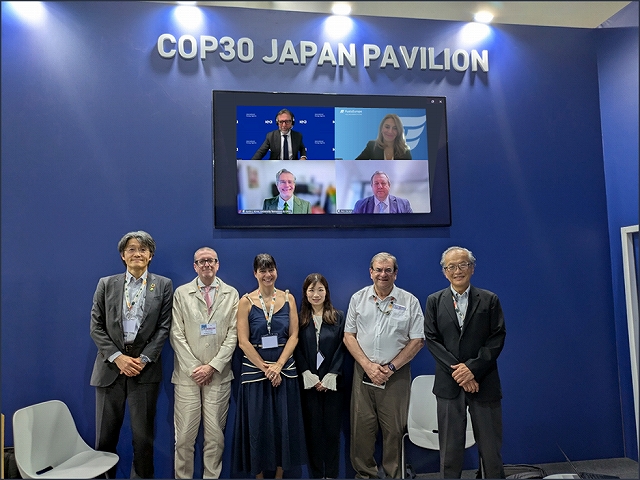
Among the well-received seminars, we would like to highlight in particular Diversity toward Carbon Neutrality—Accelerating Decarbonization with Sustainable Fuels, which was hosted by the Japan Automobile Manufacturers Association (JAMA).
In the road transport sector, attention is focused on decarbonization through various pathways, particularly the importance of combining sustainable fuels—such as biofuels—with hybrid engines. The seminar opened with the attendance of officials from Brazil, Japan, and Italy, as the three countries deepen their cooperation. The panel discussion featured a wide range of global stakeholders, including the IEA, the Brazilian Association of Automotive Vehicle Manufacturers (ANFAVEA), the European Automobile Manufacturers Association (ACEA), the U.S. Oak Ridge National Laboratory, and the European Fuel Manufacturers Association (FuelsEurope). From their respective perspectives, speakers emphasized that the use of sustainable fuels in the road transport sector is crucial not only for decarbonization but also for economic growth and energy security, and that various pathways—not just electrification—are necessary.
Through this seminar, the importance of international collaboration, including the aforementioned Belém 4X Pledge on Sustainable Fuels, was reaffirmed, as was the need to further advance initiatives involving government, private sector, industry, and academia.
Group photo of the seminar speakers
The exhibitions and seminars at the Japan Pavilion were well attended each day, attracting ministerial-level visitors from more than 20 countries. COP30 served as a powerful platform for Japan to showcase its decarbonization technologies to the world.
Divisions in Charge
About this article
Global Environmental Affairs Office, GX Policy Group
About the Special Contents
Research and Public Relations Office, Commissioner’s Secretariat, ANRE
 The original Japanese text of this article; Click here