International Conferences on Sustainable Fuels and Hydrogen Held in Osaka with Expo Site Visit
Sharing Japan’s Efforts with the World (Part 2)
(Provisional translation)
(English ver.) 2026-02-13
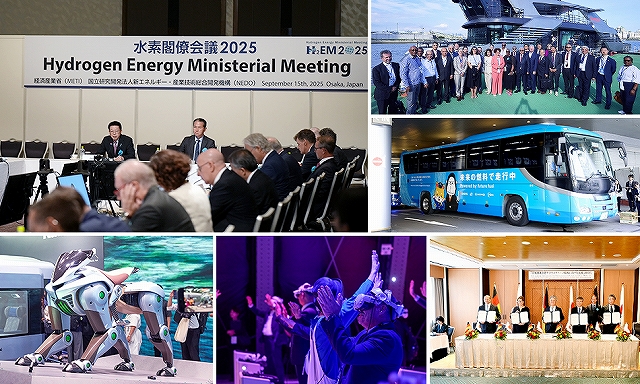
Green Transformation (GX) is one of the major efforts Japan is advancing to reform its entire economic and social system. It aims to transform the fossil fuel-centered industrial and social structure that uses coal and oil into a new structure relying on clean energy with no CO2 emissions. Japan is advancing the development and utilization of various next-generation energy sources and decarbonization technologies. International cooperation and public-private collaboration are essential for the popularization of such energy sources and technologies. To this end, on September 15, 2025, two international conferences were held in Osaka, the venue of Expo 2025 Osaka, Kansai, Japan. These were the Ministerial Meeting on Sustainable Fuels and the 7th Hydrogen Energy Ministerial Meeting. Part 2 of this article, which includes some onsite reports, presents salient points of the outcome of the 7th Hydrogen Energy Ministerial Meeting as well as details of the Expo site visit conducted after the meetings.
The Hydrogen Energy Ministerial Meeting discussed the increasing utilization of hydrogen with a view to further demand creation in the future
The Hydrogen Energy Ministerial Meeting was held for the first time in 2018, and the latest 7th meeting took place in 2025. It is one of the oldest international conferences that have been held during the Tokyo GX Week. The 7th meeting in 2025, co-hosted by the Ministry of Economy, Trade and Industry and the New Energy and Industrial Technology Development Organization (NEDO), brought together ministers and delegates of 30 countries from around the world. The meeting shared the latest information on the respective countries’ hydrogen policies and explored possibilities for policy collaboration and international cooperation to stimulate global demand for hydrogen under the theme of “demand creation.”
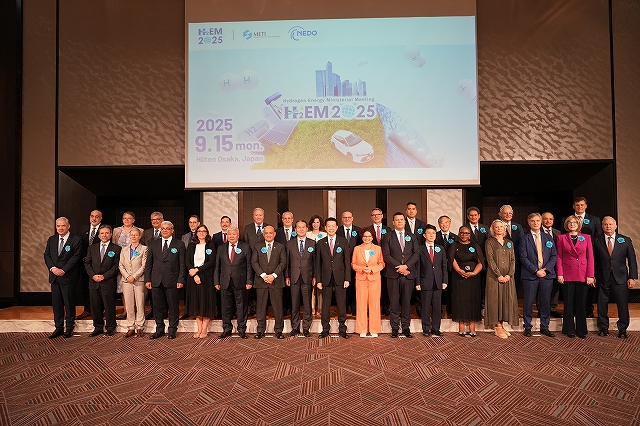
Hydrogen has emerged as a key energy source to achieve net zero. It is also conducive to energy security as a means of diversifying energy supply sources. Since 2017, countries around the world have progressively formulated national hydrogen strategies. To date, 65 countries are making concrete efforts to achieve their goals in 2030 and beyond.
The meeting began with the presentation by the International Energy Agency (IEA) on its report titled Global Hydrogen Review 2025. According to the report, low-emission hydrogen production could reach 37 million tons per annum (Mtpa) by 2030, out of which 4.2 Mtpa are operational, under construction or have reached final investment decisions (FID) as of the end of July 2025 (fivefold over the previous year). In 2024, 1.9 Mtpa of new long-term offtake agreements were signed.
Participating countries and delegations shared information regarding their hydrogen policies to confirm steady progress in hydrogen utilization. According to a report by the Hydrogen Council, currently more than 500 projects are past FID or already operational with investment commitments exceeding USD 110 billion while only 50 projects have been publicly cancelled in the past 18 months.
It is necessary to accelerate the introduction of hydrogen in the future. However, due to the impact of recent global inflation, hydrogen supply costs remain high compared to conventional fossil fuels. Support measures need to be implemented for hydrogen to become cost competitive.
Under such circumstances, global demand creation of hydrogen was one of the main agenda items of the conference. If hydrogen utilization expands and trading volumes increase, a virtuous cycle can emerge in which supply costs decline, thereby creating further demand. Continued commitment by each country to advance policies aimed at the expansion of hydrogen utilization is imperative. To establish such a virtuous cycle, governments are expected to take policy initiatives for the expanded utilization of hydrogen and promote innovation in each sector of the hydrogen supply chain.
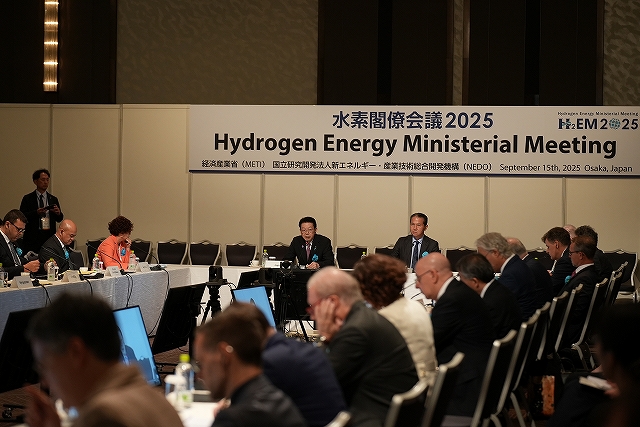
METI Minister Muto appeals to the delegates of countries and organizations in attendance about the necessity of hydrogen demand creation.
Furthermore, as a supply chain cannot be built by a single country, demand creation on a global scale is needed. It is crucial that as many countries as possible become consumers of hydrogen and connect the points of supply and demand between each country to foster an international hydrogen supply chain. To this end, the Hydrogen Energy Ministerial Meeting shared the importance of global demand creation.
Ministers and delegates in attendance requested the leading organizations including the International Energy Agency (IEA), World Bank, and International Partnership for Hydrogen and Fuel Cells in the Economy (IPHE) to take actions on these issues individually and collaboratively. Cooperation through the international frameworks, such as COP, G7, and G20, is also considered critical.
It was also agreed that the International Conference on Fuel Ammonia would be consolidated into the Hydrogen Energy Ministerial Meeting for integrated policies to further expand the utilization of hydrogen and its derivatives.
More information on ammonia can be found in the following article.
You can find more details about the outcome of the conference here.
On the same day, three Japanese companies and two German companies (listed below) signed a Memorandum of Understanding (MOU) of cooperation toward Japan-Germany hydrogen supply chain development.
Japanese companies:
Kawasaki Heavy Industries, Ltd.
Toyota Motor Corporation
The Kansai Electric Power Company, Incorporated
German companies:
Daimler Truck AG
Hamburger Hafen und Logistik AG (HHLA)
The MOU was signed in the presence of Commissioner of the Agency for Natural Resources and Energy of Japan and Director General Heat, Hydrogen, and Efficiency at the German Federal Ministry for Economic Affairs and Energy (BMWE).
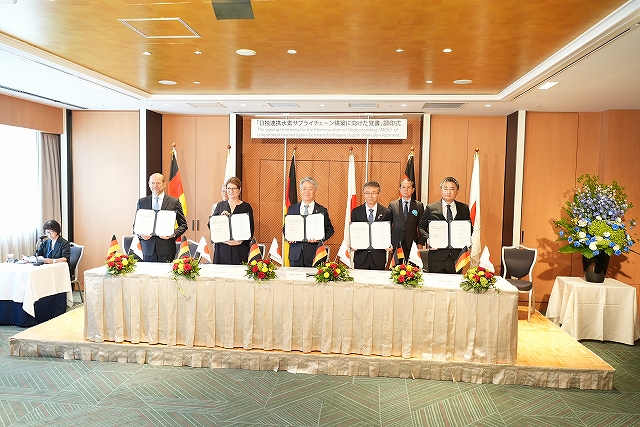
Three Japanese companies and two German companies sign a Memorandum of Understanding (MOU) on hydrogen supply chain development.
Parties to the MOU are leading global companies in the fields of liquefied hydrogen, which will play the key role in mass transportation, and mobility and power generation, which will form the basis of hydrogen demand. Furthermore, HHLA’s logistics network covers seaport terminals that will play an important role in hydrogen loading and unloading operations. Aiming to promote the global utilization of hydrogen, the goal of the MOU is for Japan and Germany to work together to establish a competitive hydrogen supply chain, including developing shared hydrogen production and shipping bases to meet the combined demand of the two countries.
Demonstrating Japanese technologies to the world: e-fuel bus, hydrogen fuel cell ship, and EXPO site tour
After the two conferences, participants were invited to an Expo site tour. They moved to the venue on Japan’s first e-fuel-powered bus. In the bus, a presentation was made on the production process of e-fuel along with Japanese companies’ efforts regarding this energy source.
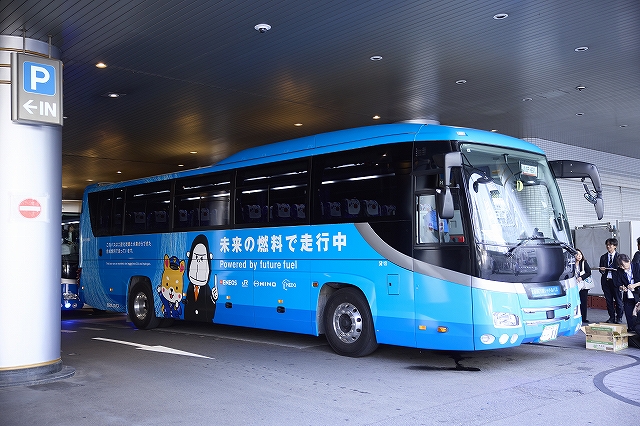
Japan’s first bus powered by e-fuel
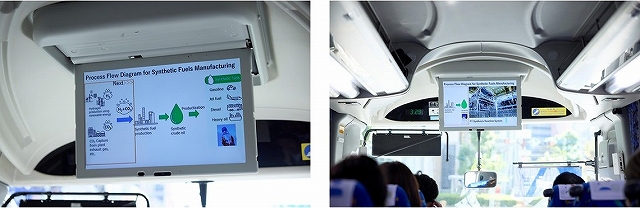
Video clip showing the production process of e-fuel
Visitors approached the Expo site via a sea route on Mahoroba, a hydrogen fuel cell ship.
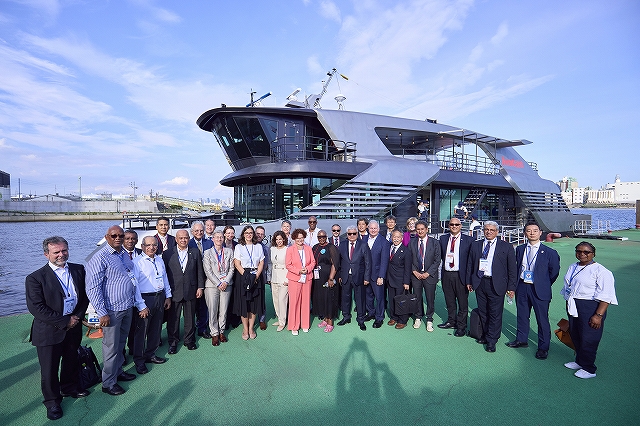
Hydrogen fuel cell ship Mahoroba and participants
Enjoying the atmosphere free from fuel odors and loud engine noises, visitors on board watched a movie showing the mechanism of Mahoroba and the potential of hydrogen. They enjoyed a 30-minute cruise viewing the scenery of the city of Osaka, which is lined with unique buildings.
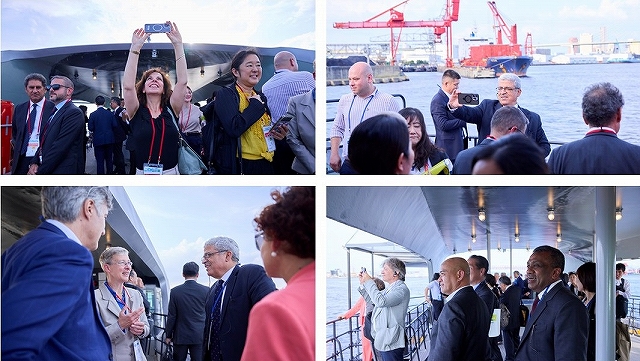
On board the hydrogen fuel cell ship Mahoroba, participants took pictures and mingled with each other.
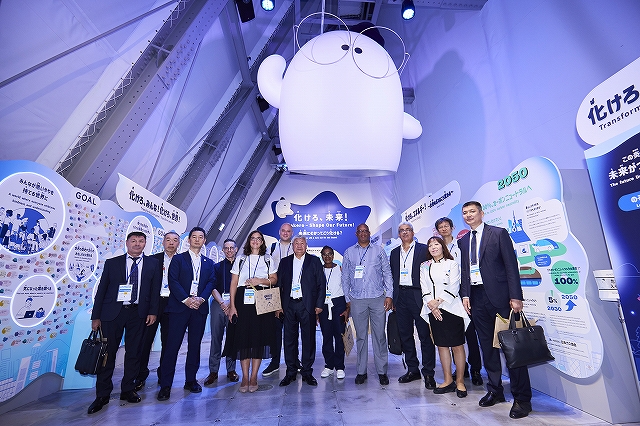
Visitors were first led to the Future City Pavillion, where the Expo 2025 Osaka, Kansai, Japan and 12 companies and organizations sponsored attractions. They experienced Society 5.0 as a model simulating a future society and viewed hydrogen-related technologies on display.
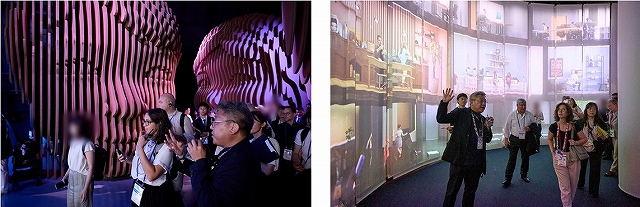
Future City Pavillion uses various visual technologies to show Society 5.0.
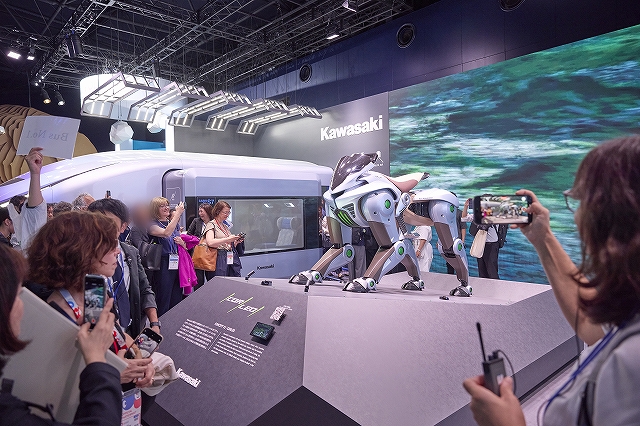
Participants take pictures of CORLEO, the concept model hydrogen-powered offroad personal mobility device developed by Kawasaki Heavy Industries.
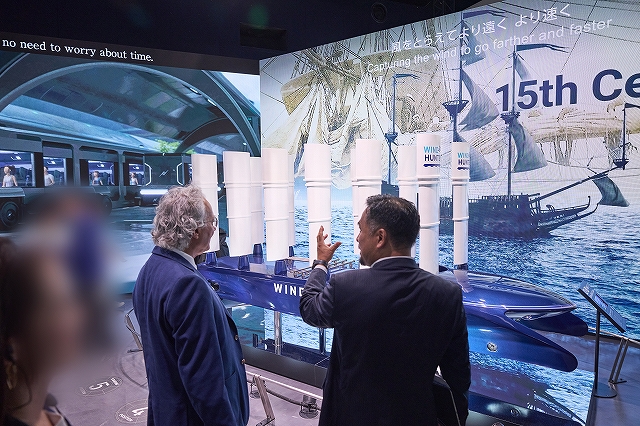
A model of the next-generation vessel Wind Hunter developed by Mitsui O.S.K. Lines attracts attention. The vessel combines offshore wind power generation and hydrogen production facilities.
At Gas Pavillion Obake (Ghosts) Wonderland sponsored by the Japan Gas Association, visitors gained a hands-on experience of an XR (extended reality) space. They also viewed displays with cute characters and exciting stories so that even children could easily understand the importance of reducing GHG emissions and the potential of e-methane.
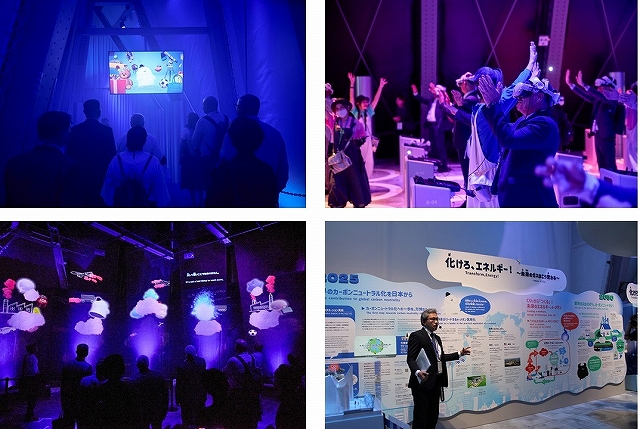
Visitors gain a hands-on experience of cutting-edge visual technologies such as VR and AR.
In the port facing the Expo site, liquefied hydrogen carrier Suiso Frontier happened to be at berth. Visitors attentively listened to the explanation of the ship, which is at the forefront of the hydrogen supply chain, while taking its pictures.
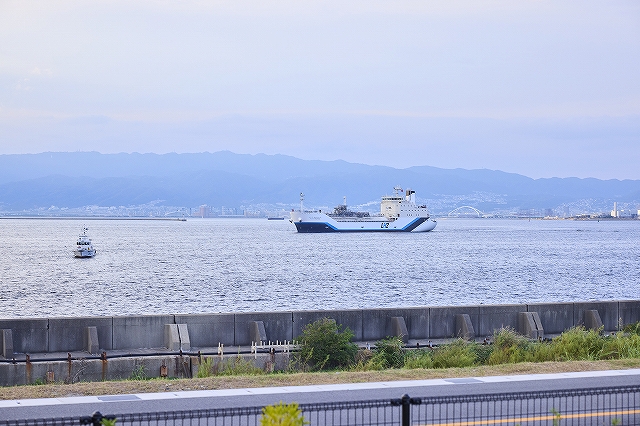
Suiso Frontier
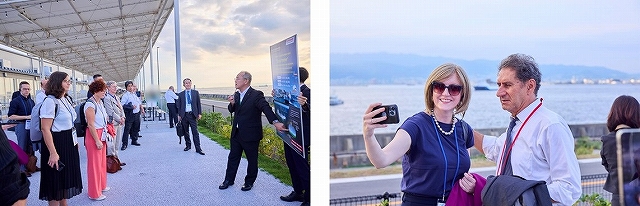
Visitors listen to the explanation about the ship while taking photographs of it.
September 15, 2025, was a memorable day when these two conferences brought together representatives from around the world to discuss policies critical for sustainable fuels and hydrogen, offering opportunities to physically experience Japan’s cutting-edge technologies for the utilization of next-generation energy. Let’s look forward to the exciting developments ahead in next-generation energy.
Divisions in Charge
About this article
Hydrogen and Ammonia Division, Energy Efficiency and Renewable Energy Department, ANRE
Fuel Supply Infrastructure Policy Division, Natural Resources and Fuel Department, ANRE
About the Special Contents
Research and Public Relations Office, Commissioner’s Secretariat, ANRE
 The original Japanese text of this article; Click here