GX Policy
Achieving Decarbonization and Economic Growth Together
(Provisional translation)
(English ver.) 2025-12-05

Green Transformation (GX) is one of the major efforts Japan is advancing to reform the entire economic and social system. It aims to transform the fossil fuel-centered industrial and social structure that uses coal and oil to a new structure relying on clean energy with no CO2 emissions. In February 2025, the Cabinet approved the 7th Strategic Energy Plan, along with the GX2040 Vision as a national strategy to show the prospects for advancing GX and related support measures. This article updates how Japan is stepping up its efforts to advance the GX policy.
Medium- to long-term directions shown in the GX2040 Vision
Japan is advancing its GX policy with the aim of simultaneously achieving a stable supply of energy, economic growth, and decarbonization, based on the 7th Strategic Energy Plan, which stipulates medium- to long-term energy policy directions. Japan will advance innovation through R&D for cutting-edge technologies to create business opportunities while leveraging GX-related technologies Japanese companies already possess. Our goal is to “win with technology and be successful in business as well”. To this end, it is essential to promote investment in R&D and in products and services that are conducive to GX.
You can find more information in the following article.
However, the world is facing an uncertain future. In the unstable international situation, involving factors such as Russia’s aggression against Ukraine and rising tensions in the Middle East, securing a stable supply of energy is a critical challenge. It is also crucial to find ways to secure decarbonized power sources to meet the increasing demand for electricity as GX and DX (digital transformation) progress.
Under such circumstances, it is important to enhance the predictability of business environments so that the industrial sector can make investment decisions with confidence. To this end, the GX2040 Vision clearly indicates long-term directions in which GX-related efforts should be made.
Creating a GX industrial structure to revitalize Japan’s economic stagnancy
GX-related efforts will create a great opportunity to break through the economic stagnation that has affected Japan over the past 30 years. Laws and strategies have been formulated to promote GX toward this end. The GX Promotion Act was enacted in 2023, and the GX promotion Strategy* was formulated based on this Act. A system referred to as the Pro-Growth Carbon Pricing Concept was introduced with regulations and support measures integrated. The Concept effectively combines carbon pricing (the emissions trading scheme and carbon surcharges for fossil fuels) and GX Economy Transition Bonds (national support for anticipatory investments) to encourage private investments.
* The Strategy for Promoting Structural Transition based on Decarbonization
You can find more information in the following articles.
- Japan’s energy policy toward achieving GX (Part 1)
Decarbonization will be advanced on the premise of securing a stable supply of energy - Japan’s energy policy toward achieving GX (Part 2)
Policy package toward simultaneously realizing decarbonization and economic growth
The GX2040 vision is an updated version of the GX Promotion Strategy announced in 2023. The GX2040 Vision stipulates that Japan should aim to build an industrial structure in which:
(1) new GX projects will be launched one after another, taking advantage of innovative technologies, and
(2) a comprehensive supply chain from materials to products in which Japan has prowess will be further enhanced by decarbonized energy sources and DX.
Various efforts will be made to achieve such an industrial structure.
Advancing public implementation of innovative technologies
Although Japan has technologies and human resources for innovation, it has not been successful enough in speedy commercialization and a large-scale roll-out. It is necessary to create a new industry by expediting the public implementation of innovative technologies.
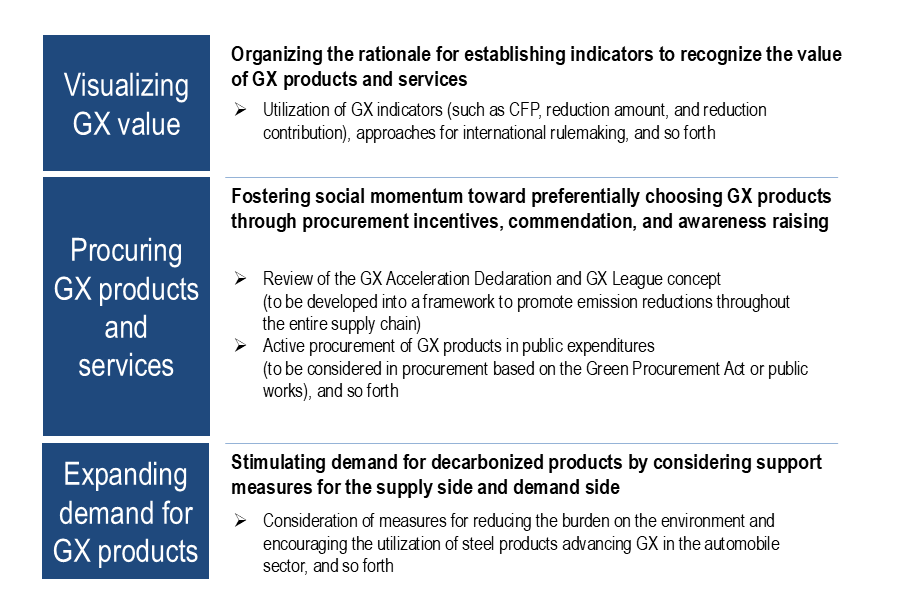
Developing a market in which GX products are valued
Some products manufactured by clean energy have higher production costs with the same performance and appearance. For instance, steel products manufactured by conventional technology using fossil fuels have the same quality as that of products manufactured by hydrogen-reduction steelmaking with less CO2 emissions. To advance GX in such an area, we need to develop a market in which the demand side or consumers can recognize the value of decarbonized products and technologies and will bear the reasonable cost increase.
Efforts toward creating a GX market
Supporting GX efforts by medium-sized companies and SMEs
Efforts toward decarbonization by medium-sized companies and SMEs may not increase their sales in most cases. Their efforts also tend to be discouraged due to the lack of human resources, know-how, and funds. However, there are increasing cases in which large companies inside and outside the country demand that their business partners reduce CO2 emissions. Therefore, efforts toward decarbonization are one of the crucial factors which affect industrial competitiveness. Companies that do not advance their efforts for decarbonization may face the risk of being expelled from the supply chain. We will take measures targeting companies that are facing such a risk.
Challenges facing SMEs in their efforts for GX
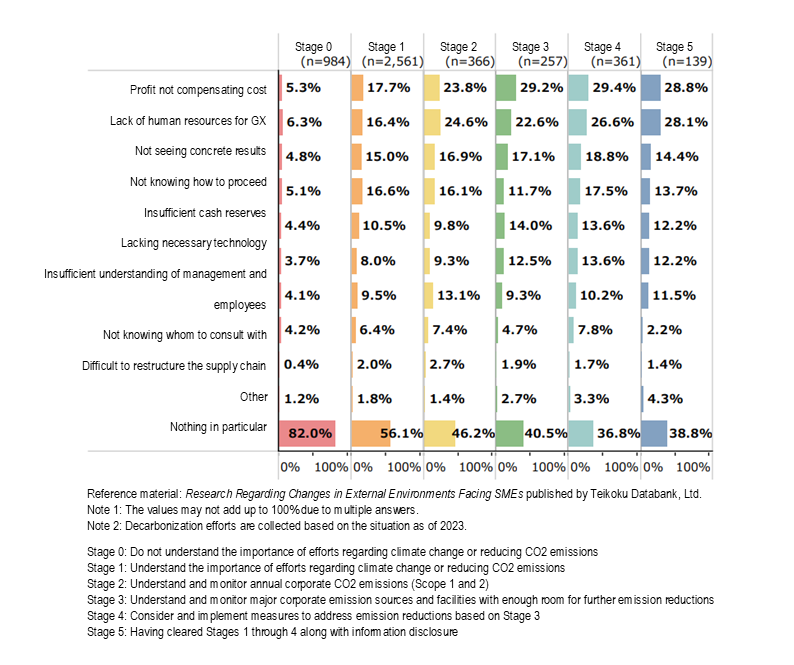
Source: Created by GX Promotion Office of Cabinet Secretariat based on the 2024 White Paper on Small and Medium Enterprises in Japan
These measures include the following.
-Improving the energy efficiency diagnosis project so that medium-sized companies and SMEs can easily calculate and visualize their energy consumption and CO2 emissions
-Supporting the introduction of equipment with improved energy efficiency
-Providing corporate support in collaboration with financial institutions and supporting organizations
Establishing industrial clusters near decarbonized power sources—GX industrial locations
It is important to select suitable industrial locations for transformation to a GX industrial structure.
As decarbonization is becoming more and more important, products and services produced with clean energy such as decarbonized power sources are expected to create new added value. Furthermore, DX and GX involving the utilization of generative AI will increase the demand for electricity, the procurement of which, particularly from decarbonized power sources, is a critical challenge for businesses.
Increasing demand for electricity by data centers
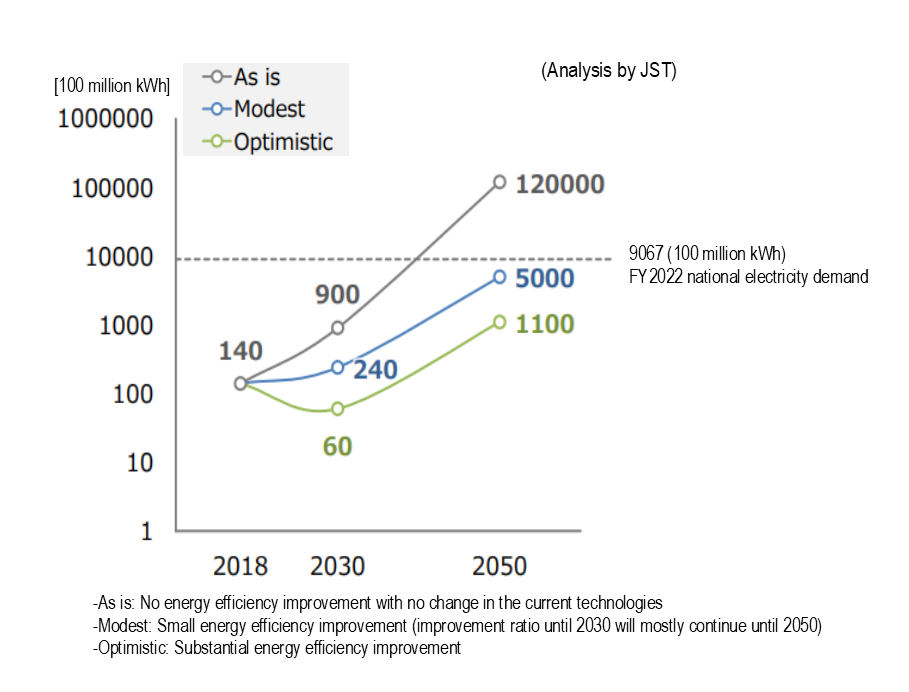
Source: Material 1 of the document distributed at the 56th meeting of the Strategic Policy Committee under the Advisory Committee for Natural Resources and Energy
The utilization of decarbonized power sources is expanding globally involving big tech companies. For instance, Amazon bought a nuclear-powered data center to directly receive clean electricity. It has also announced agreements to invest in multiple enterprises that are developing small modular reactors (SMRs), a next generation type of nuclear reactor. Furthermore, Constellation Energy, a power company in the United States, announced the signing of a 20-year power purchase agreement with Microsoft and the restart of Three Mile Island Unit 1, which has been out of service for economic reasons.
In such global trends, Japan aims to build new industrial clusters by attracting corporate investments into locations with an abundance of clean energy such as decarbonized power sources. If local municipalities, where decarbonized power sources are located, invite companies to build factories, it will create jobs and procurement of components, which will have an economic ripple effect leading to the revitalization of the regions.
Conceptual links between investment promotion measures and industrial locations
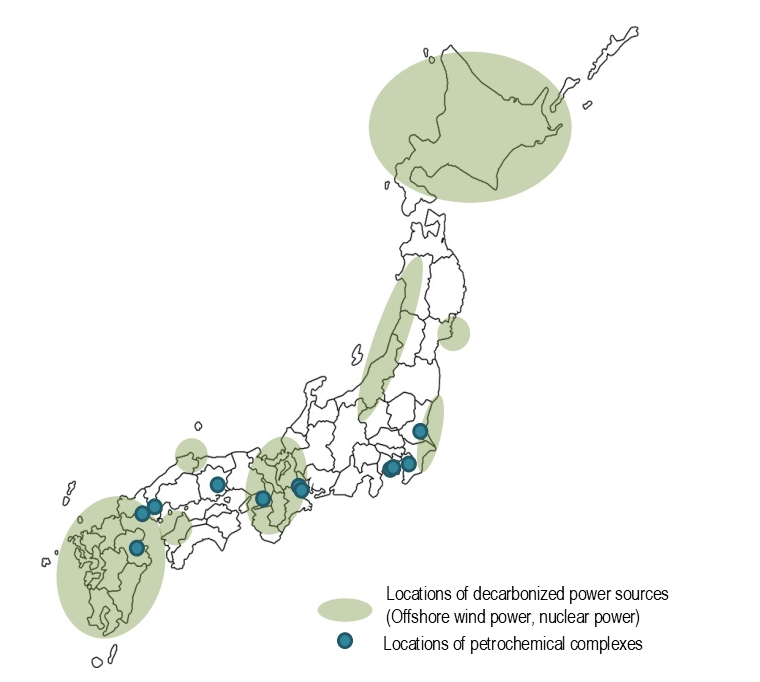
Source: Outline of the GX2040 Vision
Mismatches between data center locations and photovoltaic power generation capacity
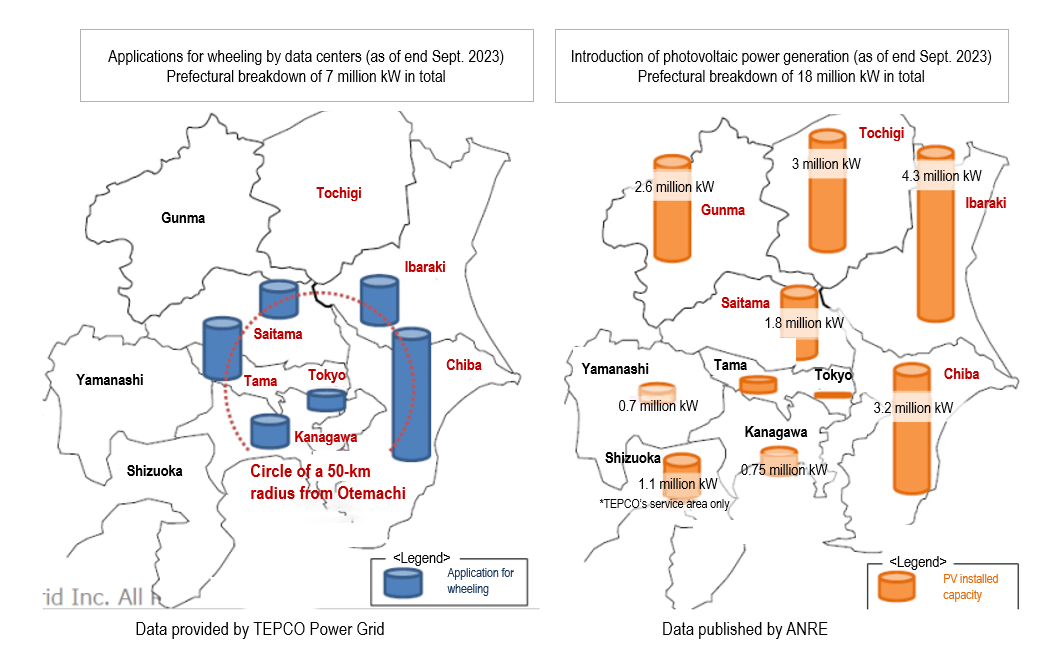
Source: Created by METI based on the data presented by Mr. Hiroshi Okamoto at the GX2040 Leaders Panel on July 23, 2024
Pro-Growth Carbon Pricing to increase the predictability of investment
The scale of investment toward achieving GX is expected to be 150 trillion yen, which will be made through public-private collaboration over the coming ten years. Enhancing the predictability of profitability is the key to encouraging proactive investments by the private sector. One of the methods for increasing predictability is Pro-Growth Carbon Pricing, which is to take support measures and regulatory/institutional approaches in an integrated manner for businesses to make proactive investments.
Pro-growth Carbon Pricing Concept
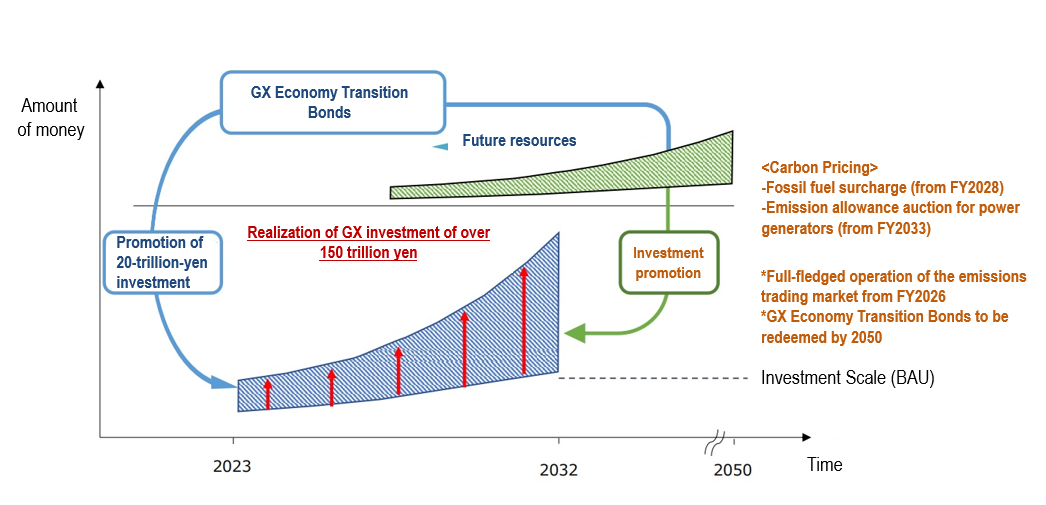
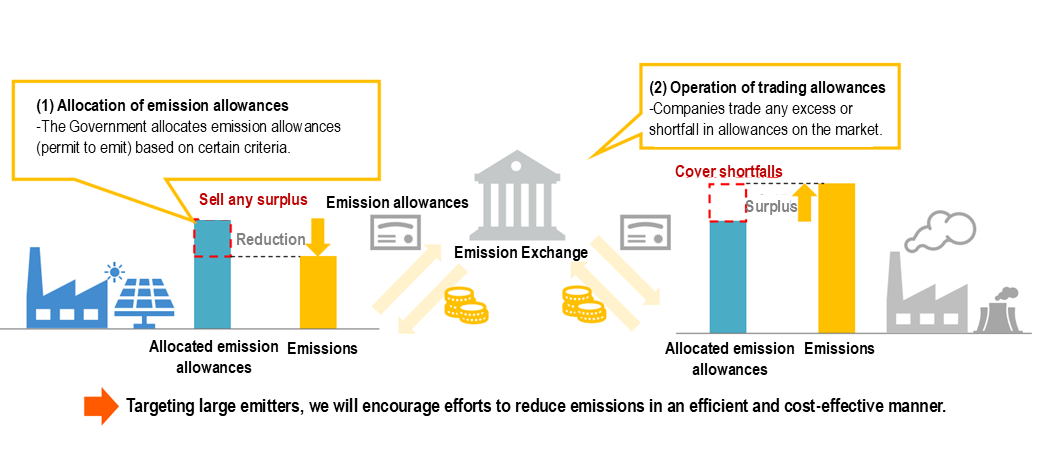
More specifically, the government will issue GX Economy Transition Bonds to provide support in the order of 20 trillion yen for advance investment by the private sector over the coming ten years. An emissions trading system will be in full-fledged operation from FY2026 whereby companies can trade their CO2 emission allowances among themselves. Furthermore, a fossil fuel surcharge will be introduced from FY2028. It will be imposed on importers of fossil fuels at the time of importation in proportion to their carbon emissions when they are used. The emissions trading system targets companies whose CO2 emissions exceed a certain threshold. The Government will allocate free allowances to target companies, and they will trade any excess or shortfall in allowances on the market. In order to develop an environment in which companies can make GX investment decisions with confidence, we will consider ensuring the predictability of carbon pricing by setting the upper and lower limits of the prices of emission allowances.
Mechanism of an emission trading system
Realistic approach to transition
As energy prices are surging in the unstable international situation, energy security is becoming more critical than ever. Japan will steadily advance decarbonization in each sector by transitioning from fossil fuels to clean energy in a realistic manner. This will help prevent the outflow of industry to other countries.
Comparison of energy prices in major countries
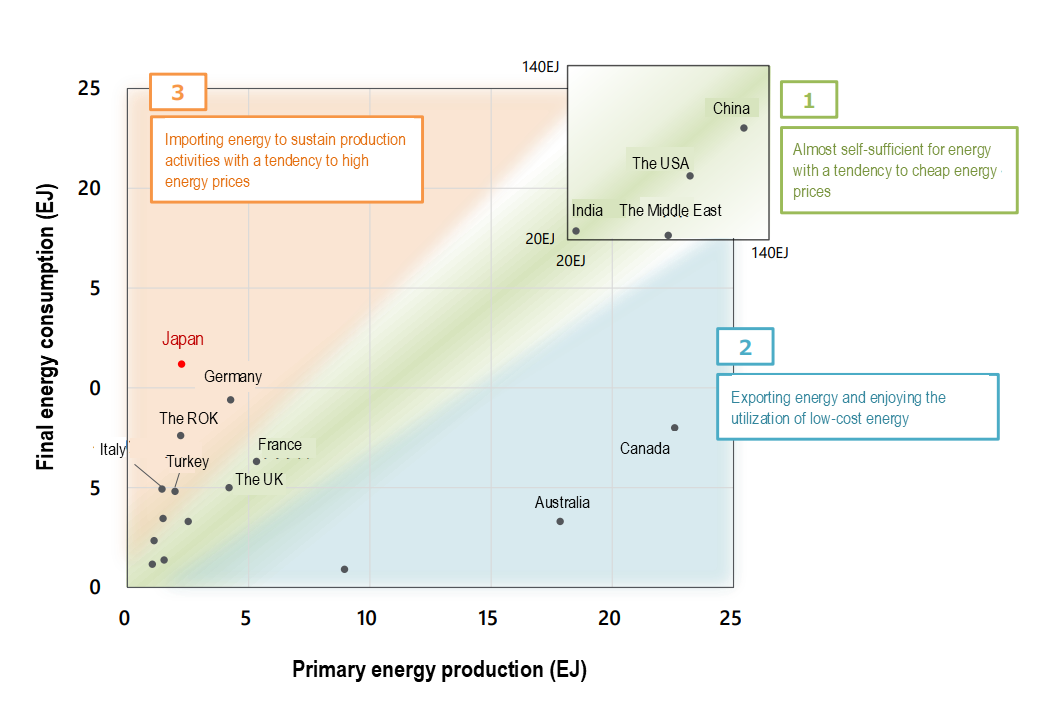
Source: Created by GX Promotion Office of Cabinet Secretariat based on the IEA World Energy Balances (2023) and other data
Japan is expanding these efforts into Asia. The Southeast Asian countries have a common situation with Japan as they rely mostly on thermal power generation for power supply and have flourishing manufacturing industries. We will strengthen cooperation with them by working together through initiatives such as the Asia Zero Emission Community (AZEC). We will leverage Japan’s knowledge to advance toward net zero GHG emissions through diverse and realistic pathways based on the respective countries’ situations. By doing so, we will contribute to decarbonization worldwide, particularly in Asia.
We will advance proactive GX efforts in a variety of fields including energy, manufacturing, transport, and daily living.
Energy policies and industrial policies are inseparable. Going forward, we will accelerate efforts toward realizing a stable supply of energy, economic growth, and decarbonization at the same time by advancing the 7th Strategic Energy Plan and the GX2040 Vision in an integrated manner.
Divisions in Charge
About this article
GX Investment Promotion Division, GX Policy Group, METI
About the Special Contents
Research and Public Relations Office, Commissioner’s Secretariat, ANRE
 The original Japanese text of this article; Click here