GX advances in the Steel Industry: Government Support for the Spread of “Green Steel”
(Provisional translation)
(English ver.) 2026-06-30
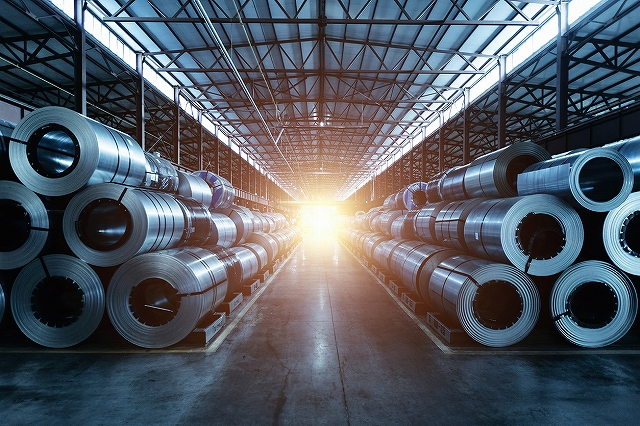
To achieve carbon neutrality by 2050, it is essential not only to transition to clean energy but also to decarbonize industries, which are major sources of CO2 emissions. In Japan, the manufacturing sector accounts for a significant portion of CO2 emissions, with the steel industry alone responsible for one-third of that total. Therefore, promoting GX (Green Transformation) in this sector is of utmost importance. However, reducing emissions in steel manufacturing processes is challenging, and there are various issues that need to be addressed. This article introduces the current status of decarbonization efforts in the steel industry—a joint public-private initiative—and the support measures currently being implemented.
The Steel Industry, a Hard-to-Abate Sector, Is Also Moving Toward Decarbonization
The steel industry is a “hard-to-abate sector”, meaning that reducing CO2 emissions is difficult. While there are several methods for producing steel, the process that generates the most CO2 is the reduction of iron ore (removing the oxygen contained in the iron ore) in a blast furnace (BF).
In contrast, the method of melting and reusing steel scrap in an electric arc furnace (EAF)—a furnace that uses electricity—allows for lower CO2 emissions. However, the supply of steel scrap is limited and cannot meet the global steel demand, which is only expected to grow significantly in the future. Furthermore, the conventional electric arc furnace process has technical problems in fully removing impurities, making it currently impossible to produce the thin, strong, and high-grade steel used in automobiles and other applications.
International Energy Agency (IEA) projections of Global Iron Input (Net-Zero 2050 Scenario)
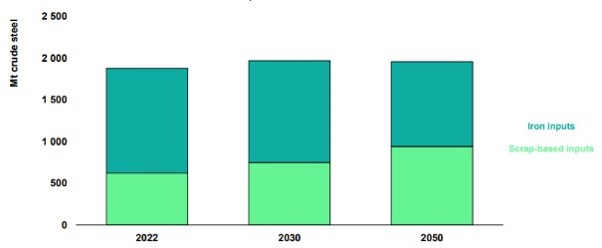
(Source: International Energy Agency (IEA))
To meet the steel demand while simultaneously reducing CO2 emissions, it is essential to further accelerate the development and implementation of various decarbonization technologies currently underway, such as hydrogen-based reduction technologies.
Image of Decarbonization of the Domestic Steel Industry
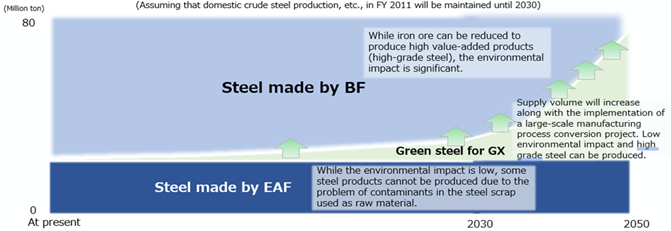
(Source: “Consolidated Summary of the Study Group on Green Steel for Green Transformation” by METI (Jan 2025).)
However, such a technological transition entails enormous costs. As a result, these costs are reflected in higher selling prices for the produced steel.
Estimated raw material and energy costs for the processing of 1 ton of iron
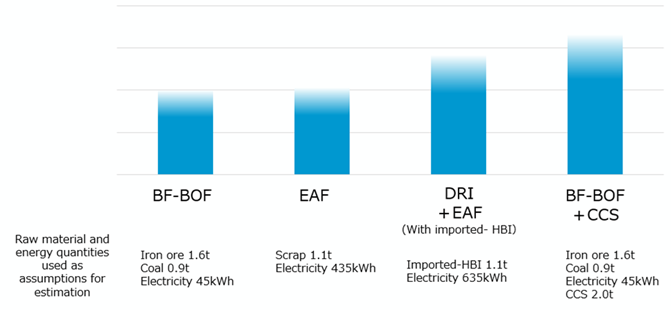
(Source: “Consolidated Summary of the Study Group on Green Steel for Green Transformation” by METI (Jan 2025).)
On the other hand, the steel produced in this way has no functional differences compared to existing products. Therefore, unless consumers recognize the “environmental value” of green steel—which significantly reduces CO2 emissions during production compared to conventional steel—it will be difficult to sell on the open market.
To cover the costs of such technological transition, it is important to promote the “visualization” of the environmental value (GX value) of the “green steel” produced through this transition, provide support for its purchase and offer incentives for purchasing it.
Furthermore, the GX value of steel with significantly reduced CO2 emissions must be internationally recognized. For example, potential purchasers of this steel include the automotive and construction industries, which need to export products overseas and attract foreign investment. To compete globally, it is essential that the GX value be internationally recognized and standardized.
The government is supporting the spread of “Green Steel for GX Promotion.”
To address these challenges, a joint public–private effort is essential. To this end, the “Study Group on Green Steel for GX Promotion” was convened five times between October 2024 and January 2025, with participation from the government, experts, and companies on both the supply and demand sides. The study group examined approaches to disseminating information on green steel to potential purchasers and to identifying challenges for market expansion, with the aim of outlining future actions.
Currently, initiatives to sell green steel in various forms are gaining momentum both domestically and internationally. However, there is no clear definition of green steel at this time, and its specifications differ among companies.
Green Steel sold by domestic and international companies
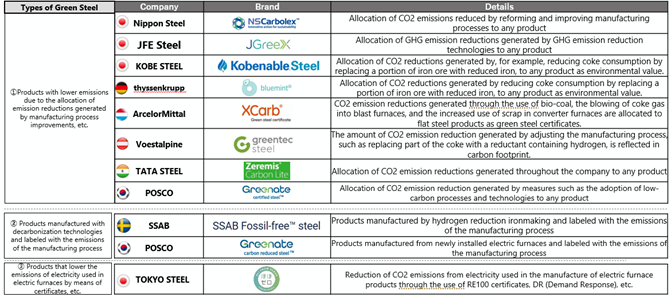
(Source: “Consolidated Summary of the Study Group on Green Steel for Green Transformation” by METI (Jan 2025).)
The Green Steel Study Group has positioned steel products that achieve significantly lower environmental impact through direct emission‑reduction actions taken by companies—and whose prices rise substantially when the associated costs of these actions are included—as “Green Steel for GX Promotion,” and has put forward a policy to provide focused support for such products.
ⅰ) Raising Awareness of GX Value and Reflecting It in International Standards
To advance GX in the steel industry, it is essential that the environmental value generated by GX products be understood by consumers, and that markets be developed to facilitate their purchase. The Carbon Footprint of Products (CFP) has long been widely used globally as an indicator of this environmental value. CFP refers to the total amount of greenhouse gas (GHG) emissions generated throughout a product’s entire lifecycle.
Taking into account the needs of steel product users in industries such as the automotive and real estate sectors, it is important that steel products with GX value be recognized—not only domestically but also internationally—as having low CFP.
ⅱ) Further Expanding the Use of CFP in Steel Products
Furthermore, by encouraging consumers to utilize CFP, we will promote the expanded use of steel products with lower environmental impact.
ⅲ) Engagement with the Demand Side of Steel
Furthermore, with regard to “Green Steel for GX Promotion,” we will promote its market expansion by focusing on government procurement measures, including prioritizing its purchase in public procurement.
Concept of Support for Green Steel for GX Promotion and Low-CFP Steel
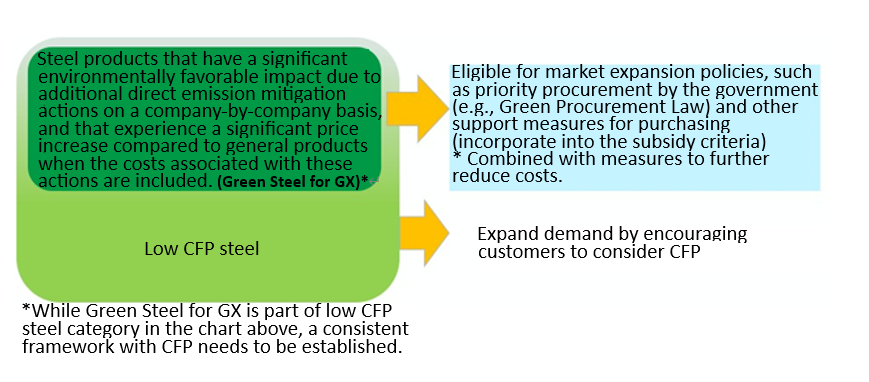
(Source: “Consolidated Summary of the Study Group on Green Steel for Green Transformation” by METI (Jan 2025).)
ⅳ) Support for Producers
Regarding the production of “Green Steel for GX Promotion,” prices tend to be higher than those of conventional products, particularly in the initial stages. We will continue to support producers through diverse technological development, capital investment, and tax measures, while also considering measures to further reduce costs. We will also promote the effective utilization of steel scrap.
In response to these government policies, the steel industry formulated the “Guidelines for Product-Specific CFP Calculation for Steel Products” in October 2025 to establish industry-wide rules for calculating the CFP of individual steel products.
We will continue to take action to expand the market for “Green Steel for GX Promotion.”
Future Actions to Expand the Market for Green Steel for GX Promotion
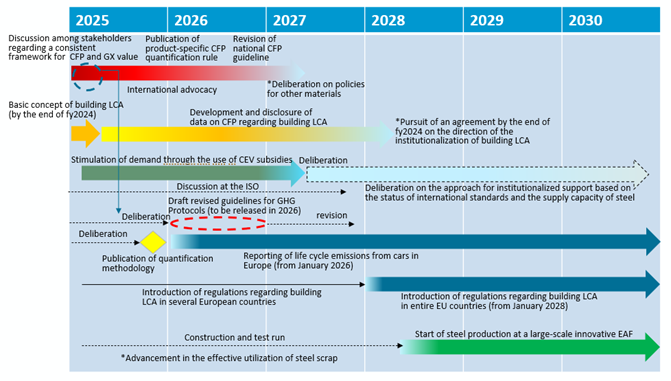
(Source: “Consolidated Summary of the Study Group on Green Steel for Green Transformation” by METI (Jan 2025).)
Divisions in Charge
About this article
Metal Industries Division, Manufacturing Industries Bureau, METI
About the Special Contents
Research and Public Relations Office, Commissioner’s Secretariat, ANRE
 The original Japanese text of this article; Click here