A Closer Look at the 7th Strategic Energy Plan
Aiming to Substantially Expand Renewable Energy
(Provisional translation)
(English ver.) 2026-01-09
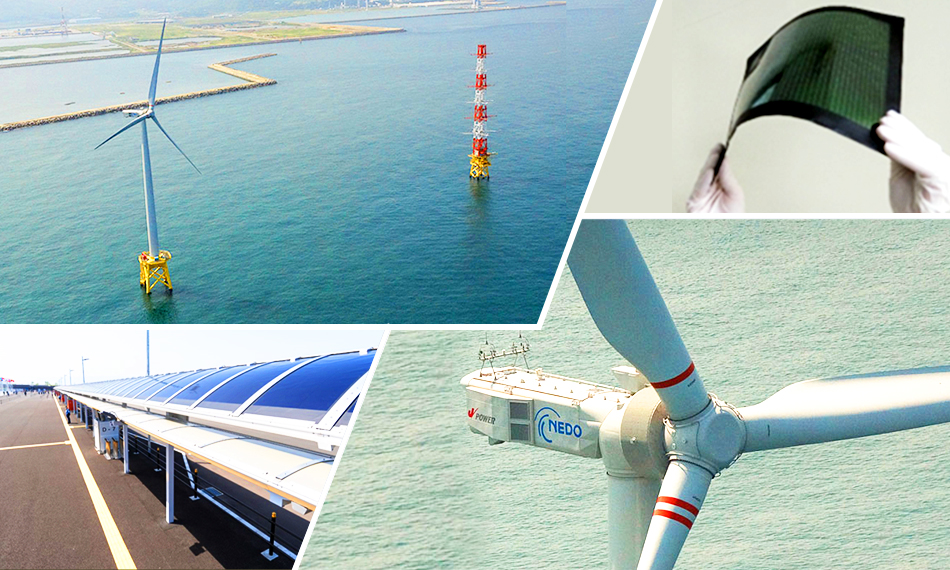
(Source) Upper left and lower right: The New Energy and Industrial Technology Development Organization (NEDO)
Upper right: Toshiba Corporation
Lower left: Sekisui Chemical Co., Ltd.
In February 2025, a cabinet decision was made on the latest 7th Strategic Energy Plan. The world is facing diverse events that have compromised energy security, such as Russia’s aggression against Ukraine and rising tensions in the Middle East, which have brought about commodity price hikes. Under such circumstances, it is critical to find ways to meet increasing electricity demand as efforts for decarbonization, digital transformation (DX) and green transformation (GX) continue to progress. Faced with an uncertain future for energy, in what direction should Japan move? A series of Special Content articles will present some insights in this regard.
As electricity demand is expected to increase for the first time in 20 years, every decarbonized power source needs to be utilized to the maximum extent possible.
In Japan, electricity demand is expected to increase for the first time in 20 years due to new construction of semiconductor plants and data centers. At the same time, we need to advance decarbonization toward achieving net zero by 2050.
National electricity demand outlook
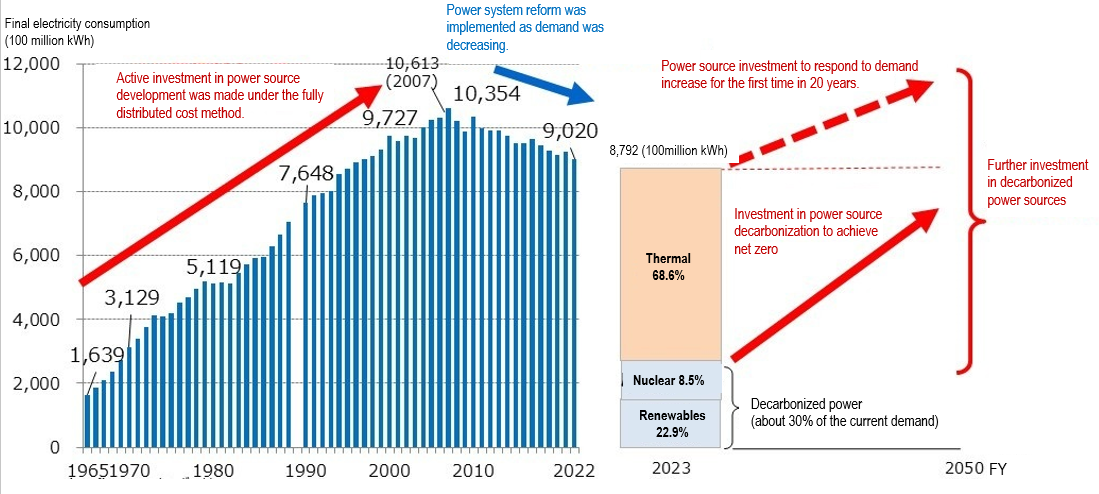
(Source) The Comprehensive Energy Statistics
Considering these circumstances, it is necessary to substantially enhance the supply capacity of decarbonized power sources that include renewable energy (e.g., photovoltaic, wind, and geothermal power) and nuclear power.
Otherwise, domestic industries would face adverse consequences, and Japan’s economic growth could be hampered.
Instead of framing renewable energy and nuclear power as opposing choices, both must be fully leveraged as decarbonized power sources. It is also essential to make large-scale investments in decarbonized power sources for a stable supply of electricity in the future.
Substantially increasing the ratio of renewable energy in the power source mix
This article highlights renewable energy among other decarbonized power sources, as the 7th Strategic Energy Plan states that Japan will promote the maximum introduction of renewable energy as a major power source.
The 7th Strategic Energy Plan and the Outlook for Energy Supply and Demand in FY2040 uphold the following policies regarding renewable energy.
S+3E as a major principle
Japan’s energy policy is based on the principle of S+3E. While maintaining the fundamental principle of ensuring Safety, Japan will pursue the simultaneous achievement of Energy Security, Economic Efficiency, and the Environment. Building on this principle, we will continue our utmost efforts to make renewable energy a primary source of power toward decarbonization.
Solar power generation: Promoting the introduction of the next-generation type
Solar power generation in the power source mix is expected to expand from 9.8% in FY2023 to 23–29% in FY2040. The solar power generation capacity per unit of national land in Japan is already one of the largest among major countries in the world, and suitable spaces for the installation of solar panels on flatlands are dwindling. Going forward, the introduction of next-generation solar cells, such as perovskite solar cells, will be promoted. Perovskite solar cells, being light and flexible, can be installed on building roofs with a low load limit and walls where it is hard to install conventional solar cells.
Solar power generation capacity per unit of national land among major nations
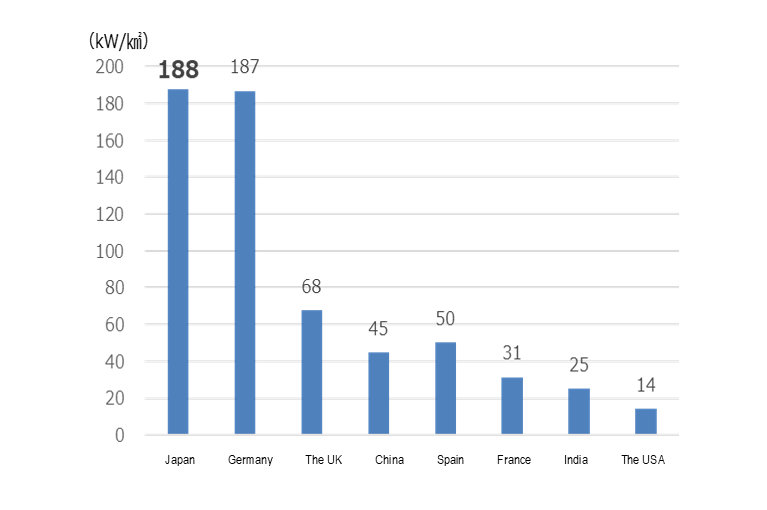
Source: Created based on the data published on the website of the Ministry of Foreign Affairs, IEA Renewables 2023, the IEA database, FIT certified capacities, and other information
Wind power generation: Expanding areas for the installation of offshore wind farms
Wind power generation in the power source mix is expected to expand from 1.1% in FY2023 to 4–8% in FY2040. Some projects have yet to start operation even after being granted authorization. We will make efforts to bring those projects onstream. As offshore wind power projects are expected to increase, we aim to expand areas for the installation of offshore wind farms beyond territorial waters into the EEZ.
Geothermal, Hydropower, biomass: Maintaining close coexistence with local communities
Regarding geothermal power generation, the Japan Organization of Metals and Energy Security (JOGMEC) will lead surveys of geothermal resources with the aim of reducing risks and costs associated with development. We will also pursue coexistence with local stakeholders including hot spring businesses.
Regarding hydropower generation, large-scale development projects involving the construction of new dams are unlikely to proceed. Even small or medium-sized hydropower generation facilities can only be constructed in more remote mountainous areas, taking a longer time for development. Considering such circumstances, we will make efforts to reduce risks and costs. We will also modify old facilities to operate more efficiently, while maintaining coexistence with local stakeholders including farmers.
Biomass power generation in the power source mix is expected to increase from 4.1% in FY2023 to 5–6% in FY2040. We will utilize woodchips efficiently as a fuel for stable business continuation.
How to address challenges facing the introduction of renewable energy
While past Strategic Energy Plans advocated the expanded introduction of renewable energy to make it a primary source of power, the latest 7th Strategic Energy Plan also stipulates a policy to further increase decarbonized power sources including renewable energy to meet the increasing electricity demand. The following challenges must be addressed in order to introduce renewable energy to the maximum extent possible and make it a major power source.
1. Coexistence with local communities
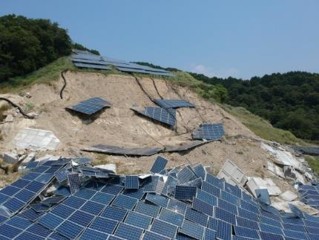
Concerns are being raised about the safety of solar panels installed on inclined terrain. There are some cases in which lack of explanation to local people is causing trouble. The FIT and FIP schemes require that businesses comply with the related laws and hold dialogue sessions with local people to obtain certification. It is important to advance reliable renewable projects by taking these measures.
Example of local troubles: Solar panels damaged by a landslide
2. Curbing the financial burden on the people
Since the Feed-in Tariff (FIT) scheme was introduced in 2012 , the general public has been bearing a part of the purchase costs of renewable energy as a surcharge, which is 3.98 yen per kWh in FY2025. Purchase prices right after the FIT scheme started were relatively high, representing a large proportion. We will try to curb the burden on the people by reducing the purchase prices and utilizing the tender system. Furthermore, from April 2022 , the FIT/FIP certification invalidation system was introduced. Some projects have not started operation for a long period after FIT/FIP certifications were granted with high purchase prices maintained (non-operational projects). Under this system, the FIT/FIP certifications granted to non-operational projects are to be invalidated. To date, approximately 80,000 certifications have been invalidated, leading to a substantial decrease in public burdens.
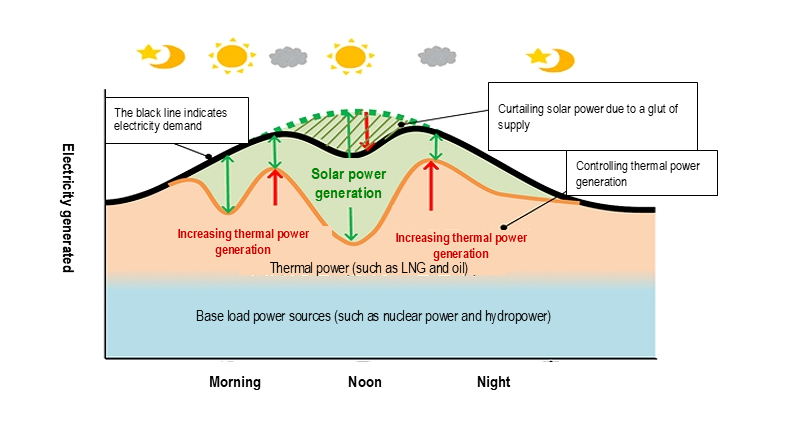
3. Addressing output variations of renewable energy
The power generation (supply) should be balanced with consumption (demand) at all times. The amount of electricity generated by renewable energy varies significantly depending on the weather and season. The output fluctuations of renewable energy need to be compensated for so that supply and demand can be balanced. Therefore, we will advance the enhancement of cross-regional transmission lines and the development of storage batteries to adjust the output variations of renewable energy.
Example of a supply/demand situation
4. Coping with used solar panels
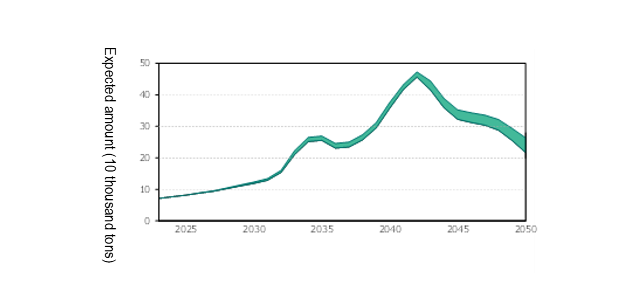
Projections indicate that the amount of used solar panels will increase significantly, reaching 500,000 tons per year from the latter part of the 2030s. Currently, recycling is not mandatory, and there are concerns that the capacity of final disposal sites will be strained. Therefore, we will make efforts to develop environments in which recycling will be conducted properly.
Outlook for used solar panels
5. Accelerating innovation
To expand renewable energy and make it a primary source of power, it is necessary to introduce next-generation renewable energy technologies. In introducing new technologies, we aim to raise the technology self-sufficiency ratio, which will contribute to the strengthening of Japan’s industrial competitiveness, including the establishment of industrial supply chains within the country.
Perovskite solar cells
In Japan, there are a decreasing number of suitable sites for installing solar power generation facilities on flatlands. Therefore, the utilization of perovskite solar cells is considered promising. Being thin and light, they can be installed in spaces such as building roofs with a low load limit, where it is hard to install conventional solar cells.
The primary material for producing perovskite solar cells is iodine, and Japan has the second largest share (about 30%) of its global production, which will enable the construction of a resilient supply chain and contribute to a stable supply of energy. We will advance the development of business environments toward early public implementation.
Offshore wind power generation
In order to expand suitable areas for installing offshore wind farms, institutional arrangements will be considered so that they can be installed within Japan’s EEZ. Efforts will be made toward public implementation, including technological development for cost reduction and mass production, and the establishment of a supply chain within the country.
*********
Going forward, we will advance our efforts to make renewable energy a primary source of power by introducing it to the maximum extent possible. In doing so, we will address the challenges described above, namely coexistence with local communities, curbing public burdens, responding to output variations, coping with used solar panels, and accelerating innovation to introduce next-generation renewable energy technologies.
Divisions in Charge
About this article
Energy Efficiency and Renewable Energy Department, ANRE
About the Special Contents
Research and Public Relations Office, Commissioner’s Secretariat, ANRE
 The original Japanese text of this article; Click here