A Closer Look at the 7th Strategic Energy Plan
Shifting from Technological Development to Public Implementation Toward the Realization of a Hydrogen-Based Society
(Provisional translation)
(English ver.) 2025-11-28
In February 2025, a cabinet decision was made on the latest 7th Strategic Energy Plan, which shows the basic direction of Japan’s energy policy. The world is facing diverse events that have compromised energy security, such as Russia’s aggression against Ukraine, which has brought about commodity price hikes. Under such circumstances, it is crucial to respond to the ever-increasing demand for electricity while making efforts toward decarbonization. We will explain in a series of articles how Japan should determine its course of action despite the unclear future prospects for energy. This article highlights next-generation energy sources, such as hydrogen and ammonia, which are currently attracting much attention.
The 7th Strategic Energy Plan advocates the active introduction of next-generation energy sources
Hydrogen and its chemical compound ammonia, along with e-methane and e-fuels, are deemed to be next-generation energy sources and are collectively referred to as “hydrogen and its derivatives” in Japan’s energy policy. To achieve net zero by 2050, they are expected to be utilized in a wide range of sectors, including steelmaking, chemicals, transport, industrial heat, and power generation, particularly in industries that are hard to decarbonize with conventional technologies.
The 7th Strategic Energy Plan stipulates policies to advance the introduction of next-generation energy sources and enhance their supply system.
You can find more information in the following article.
Let us look at the direction of Japan’ energy policy, focusing on hydrogen and ammonia along with trends in other countries.
A global shift from technological development to commercialization
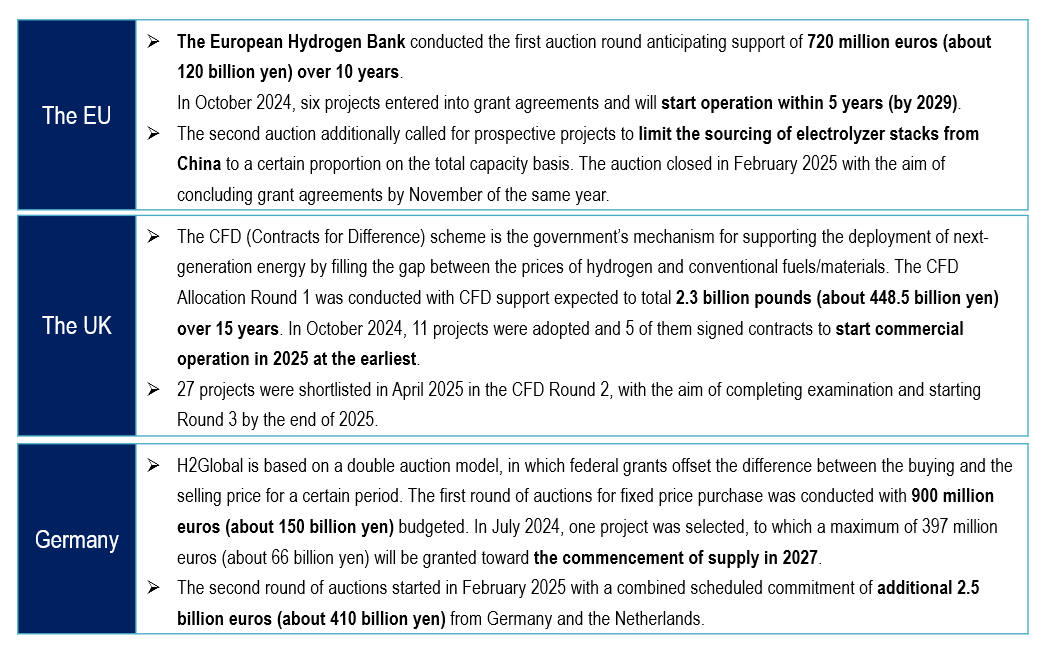
Countries around the world are gradually shifting the focus of their support for the hydrogen industry from technological development to capital investment in plant and equipment to produce low-carbon hydrogen and its derivatives with CO2 emissions during production kept below certain levels.
The hydrogen boom, which once showed rapid growth, has recently started to slow down due to rising development costs caused by inflation. In addition, investments in some hydrogen projects are stagnating due to policy uncertainties. On the other hand, long-term government support, particularly in Europe, is steadily continuing, and hydrogen-related projects are making consistent progress. This is not just a temporary boom, and serious operators are aiming to start commercial operations even before 2030.
In the EU, for example, the European Hydrogen Bank was launched to unlock private investments in green hydrogen production and promote its popularization. Furthermore, government support measures are being taken steadily in the UK and Germany. In the USA, tax credits are offered by the Inflation Reduction Act.
Hydrogen policies in major countries (support and regulatory systems)
The Hydrogen Council is a global CEO-led initiative with a united vision and long-term ambition for hydrogen to accelerate the energy transition. According to a report published by the Council, the clean hydrogen sector has reached a major milestone, with USD 110 billion in investment now committed across more than 500 projects worldwide that are past the final investment decision (FID), in construction, or already operational, while approximately 50 projects have been publicly cancelled in the past 18 months. In fact, global hydrogen production capacity has significantly increased in recent years, with some water electrolysis equipment with a capacity of tens of megawatts brought online overseas. Projects with water electrolysis equipment of hundreds of megawatts or even gigawatt-scale have been announced with mass-production plans. Despite some challenges ahead, countries around the world are steadily shifting from technological development to public implementation toward promoting a hydrogen-based society. Japan is no exception. We are advancing toward the realization of a hydrogen-based society.
You can find more information in the following article.
Providing diverse support measures toward realizing a hydrogen-based society
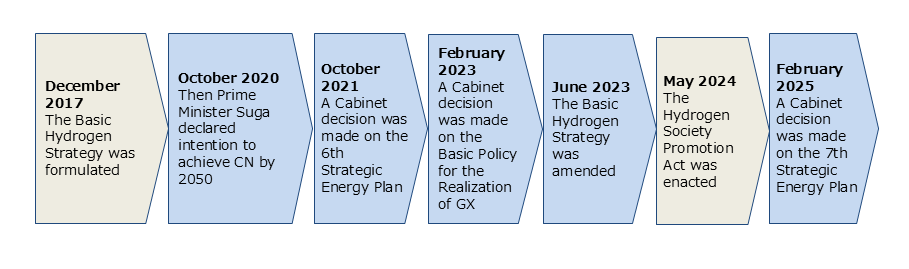
In 2017, Japan formulated the world's first national hydrogen strategy, the Basic Hydrogen Strategy, which was later amended in 2023. Whereas the original strategy focused on technical development, the revised version included industrial and safety strategies for the forthcoming commercialization stage. In 2024, the Hydrogen Society Promotion Act was enacted to develop an environment toward the forthcoming hydrogen-based society. The Act intends to integrate support and regulatory systems to expand the introduction of low-carbon hydrogen and its derivatives.
Events regarding hydrogen and its derivatives in chronological order
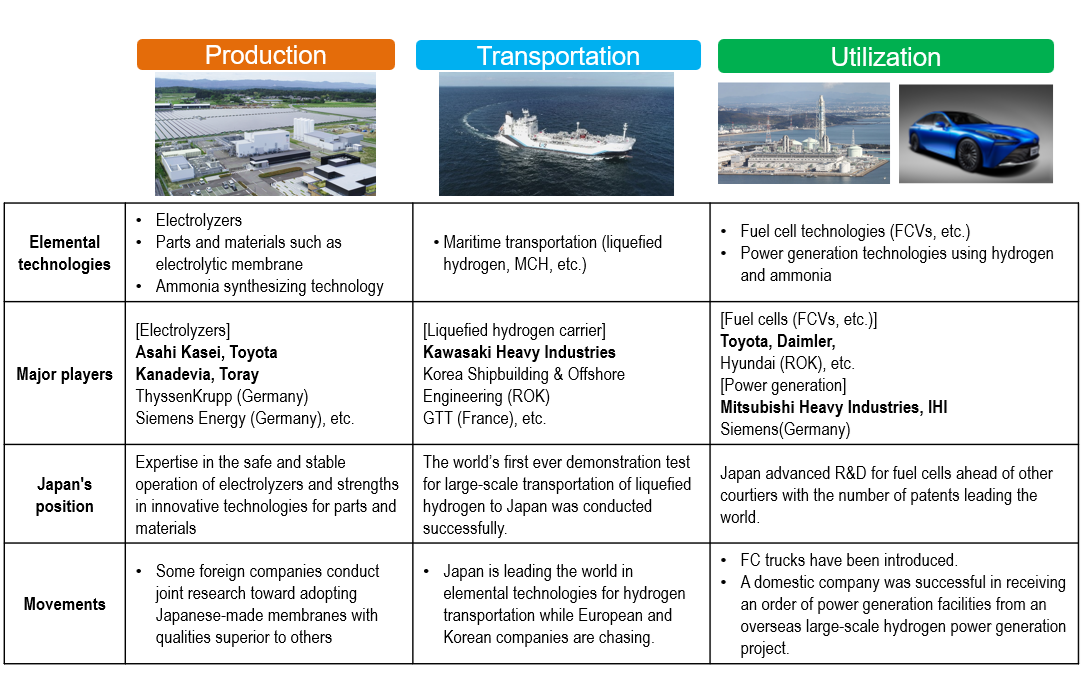
Japan has been leading the world in technologies related to hydrogen, such as its production, transportation, and combustion. For Japan to remain commercially competitive in the expanding world market, we will promote capital investment by leading companies, particularly in fields where Japan has prowess.
To utilize these technologies in society, a large-scale supply chain must be built, both domestically and globally, which encompasses the stages of production, transportation and storage, and utilization for next-generation energy sources including hydrogen.
The expansion of a hydrogen supply chain and Japan’s strengths
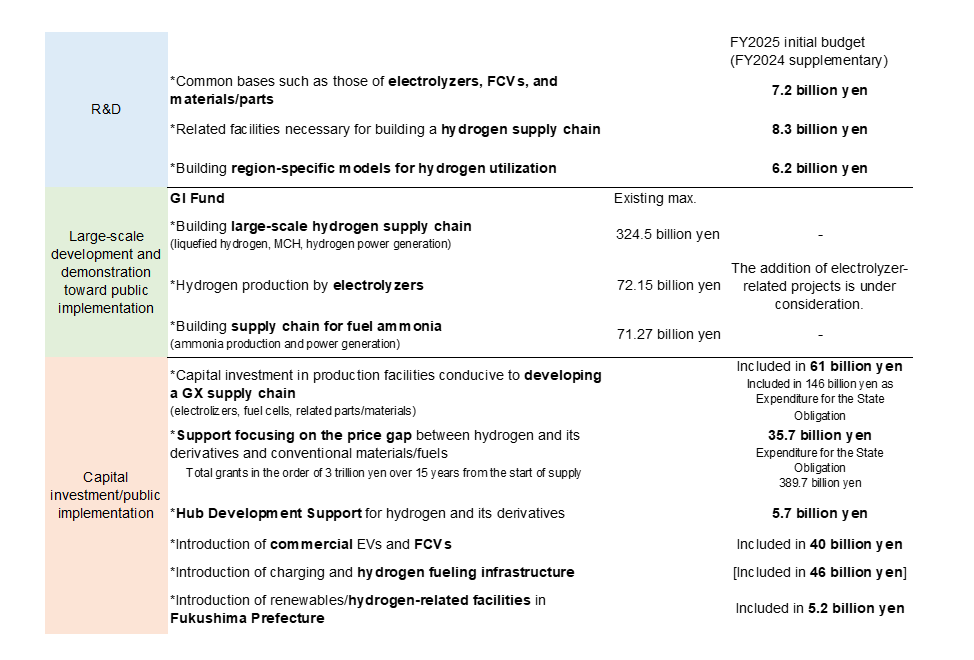
A wide range of support measures are being prepared toward building a supply chain on a commercial basis.
For one thing, hydrogen is still expensive, and it is a challenge to address the price gap with conventional materials and fuels. Therefore, support measures in the order of 3 trillion yen focusing on the price gap are being taken, targeting the costs related to not only domestic production but also overseas production and transportation.
Furthermore, diverse support measures are being prepared covering the stages from technological development to public implementation. These include the technological development of water electrolysis equipment, infrastructure development such as the construction of tanks and pipelines necessary for transportation and storage, the introduction of commercial fuel cell vehicles (FCVs), and the popularization of hydrogen stations.
Support measures toward building a hydrogen supply chain
The utilization of ammonia is also intended for expansion into the Asian market
Ammonia has traditionally been used as a base material to produce fertilizers and chemical products, and therefore a supply chain already exists, albeit of a small size. In Europe, ammonia is mainly attracting attention as a hydrogen carrier (i.e., a means of transporting hydrogen). In Asia, mixed combustion at coal-fired power stations to reduce CO2 emissions seems promising. Ammonia also has potential as a bunker fuel for international shipping. We will advance technological development and demonstration for both production and utilization with an eye to early expansion into the international market, particularly the Asian market. Ammonia can be synthesized from hydrogen, and projects for producing it are starting across the world.
Promoting lower costs and wider utilization of hydrogen and ammonia in tandem
The 7th Strategic Energy Plan stipulates that strong support will be given to the development of a large-scale supply chain for hydrogen and its derivatives based on the Hydrogen Society Promotion Act. It also states that reducing costs and expanding utilization will be promoted in tandem by integrated regulatory and support measures, taking into account trends in other countries and private companies.
Hydrogen and its derivatives are the key to achieving carbon neutrality. To further promote a hydrogen-based society, demand creation around the world is essential. At the Hydrogen Energy Ministerial Meeting held in September 2025, Japan expressed its commitment to step up efforts for global demand creation in collaboration with other countries and international organizations. We will strengthen our industrial competitiveness to win with technology and be successful in business as well. To this end, we will take advantage of our cutting-edge technologies to expand into the global market. We believe that our efforts will contribute to global decarbonization.
Divisions in Charge
About this article
Hydrogen and Ammonia Division, Energy Efficiency and Renewable Energy Department, ANRE
About the Special Contents
Research and Public Relations Office, Commissioner’s Secretariat, ANRE
 The original Japanese text of this article; Click here